Coding the Office for Focus with Super: How Spatial Design Became a Cognitive Tool in SuperSure’s Wells Fargo Center Office
The modern workplace is a space filled with invisible demands. Notification loops, fragmented workflows, and algorithmic tasking have left workers navigating a subtle cognitive drain. As productivity software evolves at hyperspeed, the irony is that humans increasingly struggle with the biology of attention itself. This tension has prompted a new frontier in workplace design, one that treats the office as a form of cognitive interface rather than a backdrop for work.
Companies experimenting in this space are beginning to engineer their offices as deliberately as they design their platf…
SuperSure’s 25,000-square-foot penthouse headquarters at Miami’s Wells Fargo Center demonstrates this shift with rare clarity. The firm commissioned the anonymous artist known as
Super Buddha
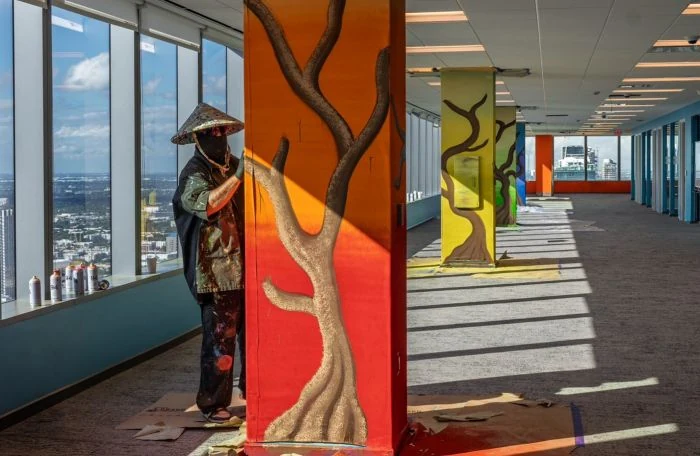
to create a workspace that is less about décor and more about cognitive architecture. The result is a behavioral landscape with a clear internal logic: circulation paths marked by shifting chromatic zones, affirmative text that serves as subtle priming, and sculptural columns that create psychological markers for workflow transitions.
The corridor of painted tree-columns creates a sequence that functions almost like a neural pathway. Each color transition registers as a quiet perceptual cue: a reminder of movement, momentum, or reset. Far from aesthetic flourish, these interventions serve as analog interfaces that guide how attention expands and contracts throughout the day.