Coding the Office for Focus with Super Super: How Spatial Design Became a Cognitive Tool in SuperSure’s Wells Fargo Center Office
The modern workplace is an space filled with invisible demands. Notification loops, fragmented workflows, and algorithmic tasking have left workers navigating an atmosphere of subtle cognitive drain. As productivity software evolves at hyperspeed, the irony is that humans increasingly struggle with the biology of attention itself. This tension has prompted a new frontier in workplace design, one that treats the office as a form of cognitive interface rather than a backdrop for work.
Companies experimenting in this space are beginning to engineer their offices as deliberately as they design their platf…
SuperSure’s 25,000-square-foot penthouse headquarters at Miami’s Wells Fargo Center demonstrates this shift with rare clarity. The firm commissioned the anonymous artist known as
Super Buddha
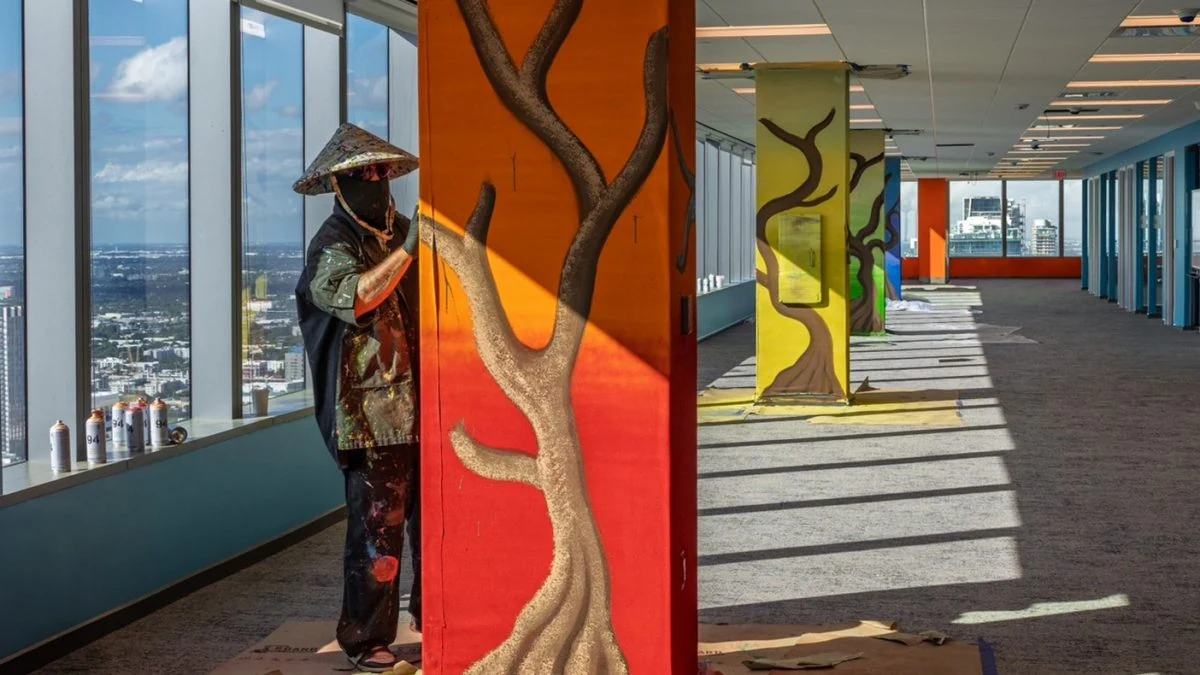
to create a workspace modeled less on décor and more on cognitive architecture. The result is a behavioral landscape with a clear internal logic: circulation paths marked by shifting chromatic zones, affirmative text acting as subtle priming, and sculptural columns that create psychological markers for transitions in workflow.
The corridor of painted tree-columns creates a sequence that functions almost like a neural pathway. Each color transition registers as a quiet perceptual cue: a reminder of movement, momentum, or reset. Far from aesthetic flourish, these interventions serve as analog interfaces that guide how attention expands and contracts throughout the day.